


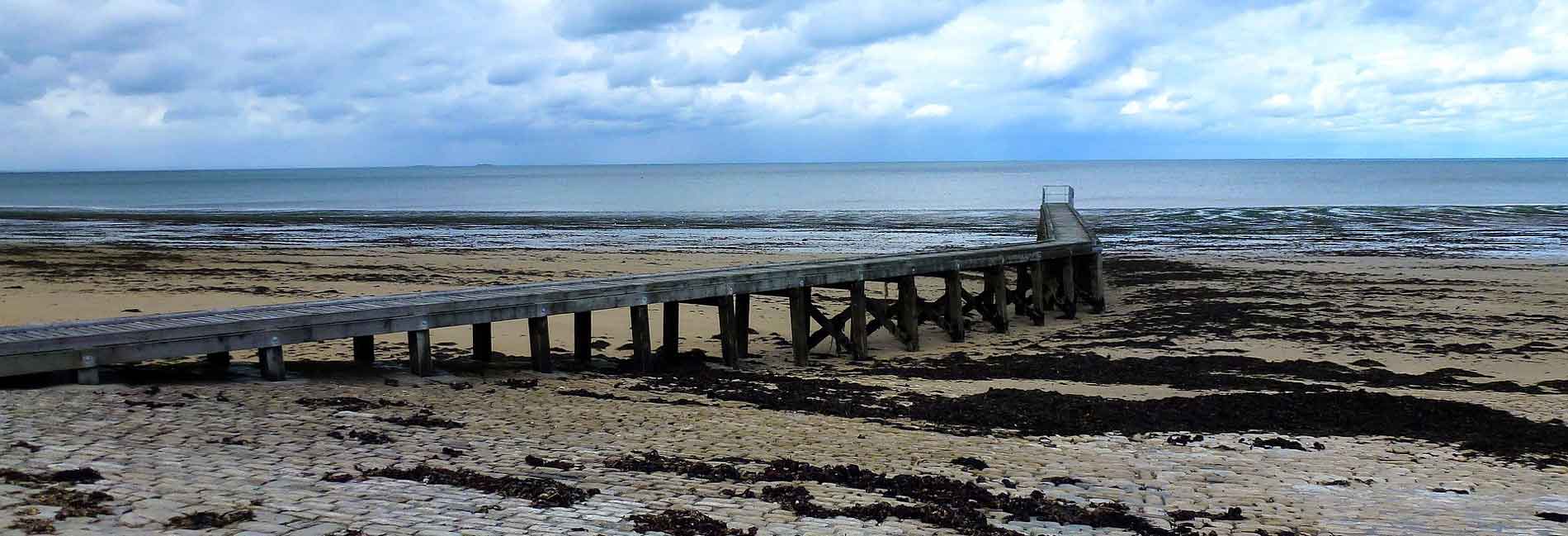


The phenomenon of tides on the Normandy coast is as majestic as it is mysterious. During your stay at Utah Beach Camping, you can experience it while respecting the schedules and recommendations.
How do tides work?
The tidal cycle is mainly due to lunar cycles. This event is linked, on the one hand, to the combined power of the earth, sea, and moon, and on the other hand, to the centrifugal force on the earth related to its rotation.
Furthermore, the influence of the moon and the sun on the seas is conditioned by their distance from Earth. It is the effect of these two forces that will cause the ocean level to vary between high and low tide.
This movement between tides is easily visible on the Cotentin coast. This variation in movement is subject to the tidal coefficient, which can fluctuate between 20 and 120. This indicates the strength of this phenomenon; the higher it is, the further the ocean recedes, and vice versa.
As the moon’s rotation around the earth is 24 hours and 50 minutes, the interval between two identical tides (high or low) is 12 hours and 25 minutes. The change from one to the other (low to high and high to low), however, occurs every 6 hours and 12 minutes.
What causes spring tides?
Spring tides are directly linked to the moon’s position in comparison to the Earth and the sun.
If the position of the three celestial bodies is in a straight line, the sun’s gravitational pull accentuates that of the moon and thus increases the magnitude of the tides. During these spring tides, checking their schedules is essential. This way, you will avoid being trapped by the rising waters, which is very rapid in this case.
If the position of the moon and the sun is perpendicular to the Earth, their gravitational pull opposes each other, and this has little or no effect on the tides. This phenomenon is called “neap tides” or “small tides.”
How to read tidal coefficients?
This is a number that specifies the strength of the tide on the coast.
When it is between 20 and 45, it indicates an absence of tide, known as “neap tide”. If it is around 70, it is an average tide. Finally, between 95 and 120, it is a spring tide, known as “great tide.”
What can you do during spring tides?
Whether high or low, spring tides allow you to practice various activities.
When they are high, you can admire the spectacle of large waves crashing on the dunes (especially during storms) or take magnificent photos during the ebb of the waters.
When the waters recede, you have the choice of going for a walk or trying your hand at traditional shore fishing (while respecting customs and obligations). The beaches, emptied of their waters, reveal all their riches in seafood (crabs, edible crabs, cockles, etc.).
The essential beaches for shore fishing are: the valleuses of Varengeville-sur-Mer, Yport beach, Étretat, and Les Petites and Grandes Dalles.
During your stay in Normandy, take a trip to Mont Saint-Michel. It offers a unique landscape in the world when the waters rise, and its rock transforms into an island.